
Heavy Metals and Autism: What We Discovered After Testing Our Son

Updated: Apr 27
One family's journey from a single hair mineral test to an 87% reduction in mercury — and measurable developmental gains along the way.
For many families living with autism, the question is never just what is happening — it's why. Behavioral therapies help. Educational support matters. But what if something deeper, something biological, was quietly influencing how the brain functioned all along?
That was the question that led our family to a hair mineral analysis test. What we found changed everything.
The Connection Between Heavy Metals and Autism
Autism Spectrum Disorder (ASD) is widely understood to be shaped by both genetic predisposition and environmental factors. Among the environmental variables under active investigation, heavy metal exposure has drawn growing scientific attention.
Metals such as mercury, lead, aluminum, cadmium, and arsenic are classified as neurotoxins — meaning they have the documented potential to disrupt normal neurological function. This risk is especially significant during early childhood, when the brain is undergoing rapid and irreversible development.
A comprehensive review of multiple peer-reviewed studies found that individuals with ASD frequently show elevated concentrations of heavy metals — particularly mercury and lead — in biological samples including hair, blood, and urine. While these findings do not establish causation on their own, the consistency of the association across independent studies is sufficient to warrant a serious, structured investigation.
"Elevated mercury and lead concentrations appear repeatedly in biological samples from individuals with autism spectrum disorder — a pattern too consistent to ignore."
Why We Chose Hair Mineral Analysis
When we decided to investigate whether heavy metals could be playing a role in our son's development, we needed a testing method that told the full story — not just a snapshot of recent exposure.
UNDERSTANDING THE TWO MAIN TESTING APPROACHES Blood testing is extracellular — it reflects recent exposure, typically within the past few days or weeks. Helpful for acute poisoning, but limited for understanding the accumulated burden. Hair mineral analysis is intracellular — it reveals what the body has stored and processed over the past 3 to 4 months, offering a broader picture of cumulative exposure and mineral balance. |
We chose hair mineral analysis because it aligned with our goal: not just confirming whether exposure had occurred, but understanding the full scope of what was present and what needed to be addressed.
When the results arrived, one finding was unmistakable: significantly elevated mercury levels.
A Structured, Monitored Approach — Not Guesswork
Armed with lab data, we worked with a practitioner to design a support plan targeted at assisting the body's natural detoxification pathways. The approach was gradual, carefully monitored, and individualized — prioritized by what the lab results indicated as most urgent.
This is what sets a data-driven approach apart from a trial-and-error one. Instead of trying interventions and hoping something works, we could see exactly where the body needed support — and track whether that support was actually producing results.
Step 1 — Baseline
Hair mineral analysis conducted. Elevated mercury identified as primary area of concern.
Step 2 — Targeted support
A personalized plan is implemented to support the body's detoxification systems safely and gradually.
Step 3 — Active monitoring
Follow-up testing at regular intervals. Behavioral observations tracked alongside lab markers.
Step 4 — Results at 10 months
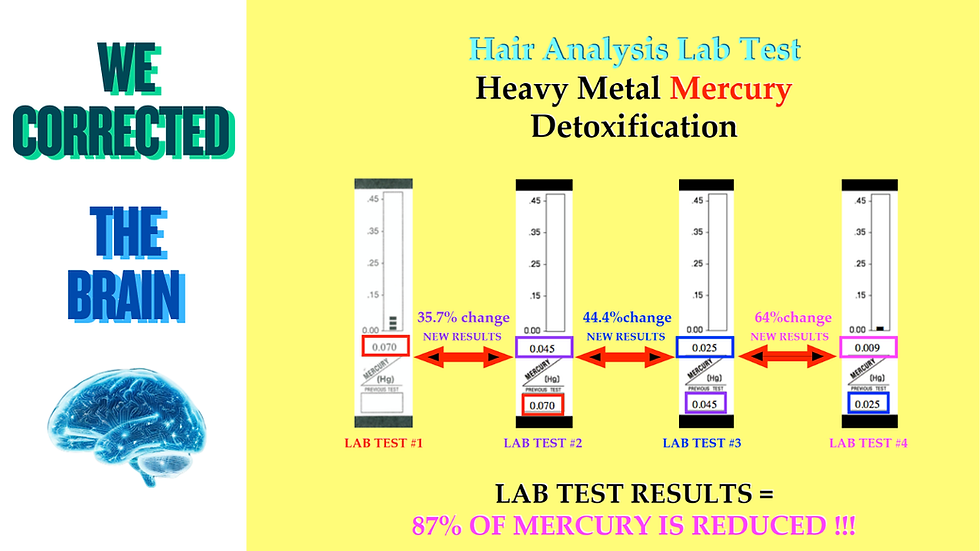
Mercury levels reduced by 87%. Measurable improvements in attention, communication, and behavior were observed.
The Results: Measurable, Meaningful Change
Over a period of ten months, follow-up testing revealed a dramatic shift. Mercury levels had decreased by 87 percent — a result that went far beyond what we had hoped for when we first started.
But numbers alone don't capture the full picture. Alongside the lab results, we began noticing changes that were impossible to attribute to coincidence. Attention improved. Engagement deepened. Communication became more spontaneous and consistent. Certain repetitive behaviors that had previously been persistent began to diminish.
Once those heavy metals were out of his brain, he flourished — in his development, in his learning, and in school. He is now on track to do great things.
What This Means for Other Families
We are not suggesting that heavy metal exposure is the cause of autism — the science does not support that claim, and oversimplifying a complex condition does a disservice to families and researchers alike. What we are saying is this: underlying biological factors deserve to be identified and addressed, not assumed away.
For every child we work with, we start with comprehensive lab testing. We identify what is present, what is elevated, and what the body needs most urgently. We explain the findings clearly to families, prioritize the areas requiring attention, and build a plan around measurable data — not guesswork.
Our lab-first protocol for autism support 1. Comprehensive intake labs — hair mineral analysis, and where indicated, blood or urine panels 2. Clear explanation of findings to the family, with prioritized areas of concern 3. Individualized support plan addressing the highest-priority biological imbalances first 4. Follow-up testing at set intervals to measure progress and adjust the plan as the body responds |
A Note on Safety: Not All Approaches Are Equal
Not all methods for reducing heavy metal levels in the body are safe. Certain aggressive chelation therapies have been associated with serious health risks and are not recommended for autism. The approach described here is gradual, professionally supervised, and grounded in regular lab monitoring. Always work with a qualified practitioner.
The Takeaway
Every child is different. Every body is different. But one thing is consistent: when you can see what is happening inside the body — when progress is measurable — you can move forward with clarity rather than hope.
Testing for heavy metals was not a cure. It was a starting point. It gave us data, data gave us direction, and direction gave us results that we can look back on today with deep gratitude.
If your child has been diagnosed with autism and you have ever wondered whether something biological might be contributing to their challenges, this is a conversation worth having. Start with the data. Let the science lead the way.
Ready to understand what's happening beneath the surface?
Learn how our lab-based approach has helped families identify and address biological factors in autism — one measurable step at a time.
Peer-Reviewed References
Disclaimer:
This content is for informational purposes only and does not constitute medical advice. Always consult a qualified healthcare professional before making any changes to your child's care plan.

Comments